8/26/14

Jan 18 -- Herp Hike

Wednesday, January 18
La Mona

We have set our alarms for 4:30, so dutifully get up, dress, and appear under the casita  at about 5:00. Susan tells us that we can go back to bed. We cannot work the mist nets in the rain. If we handle the wet birds with our wet hands, we are liable to pull off feathers. Banding and data entry are difficult to do in the rain also.

Since I am an early riser anyway, I stay up. I give myself my B12 shot thinking it will help my aching feet and  I also take my malaria pill, the side effect of which gives me a stiff neck. The cooks have hot water heated on the stove and there are candles on the table, so in the candle-lit dark, I fix myself a breakfast of cereal and fruit and coffee. I listen to the rain dripping off the trees and leaves and to the distant howler monkeys and wonder that I am sitting in the cloud forest of Ecuador thousands of miles from home.

When Susan gets up, she finds that there was a leak upstairs directly over all of her data and the computer, which we run on a car battery. We separate the wet pages of a hummingbird poll she has taken in three villages within the Reserve (Loma Alta, El Suspiro, and Dos Mangos), and we lay out her other data to dry as best as possible. Then we move the equipment from under the leak and go upstairs to try to find and plug the source. Several of the tents upstairs have leaked also. Ricardo’s and Cathy’s are wet.

After everyone has eaten breakfast, Carlos asks who would like to go for a trek with him looking for frogs, snakes, and lizards. He will take one group in the morning and one in the afternoon. I volunteer, as do Chas, Dawn, and Cathy. We hike for about 3 hours, much of our time along a small creek, occasionally needing the machete to clear a path. We find little other than chaco frogs, flowers, trees, and vines. But what strange trees . . .  The leaves of one group of cecropia trees are so riddled with insect bites that they wave far overhead like lace against the sky. Carlos and I take photos of the lacy tree.

Another tree is called a walking palm. According to Carlos, this tree will move slowly by shortening roots on one side and lengthening them on the other side. It does this if  it stands too much in the shade of another taller tree.

Then there are kapok trees with their huge buttress roots, some buttresses well over 6 feet high.  In the cloud forest, all sorts of frogs and snakes like to shelter near the base of these root “walls.”


Ferns, moss and bromeliads grow everywhere on the trees, some providing nice water catchments for small tree frogs. Many, if not most, trees are also festooned with the vines of giant-leaved philodendron.

And then there is a bamboo-like tree (below) whose every joint is spiked with 1 to 3-inch thorns. One stood near Net #9 and we had to  be careful not to grab it when climbing to the net.

Bromeliads, philodendron twinnig up a tree, the tree that protects itself with
spikes to ward off vines until it reaches the sun; bright red Helconia
flowers stand or hang from their plants
Often we’d come across clusters of tiny umbrella-like white mushrooms. I suppose the dark damp cloud forest floor is an ideal nursery for such fungi. And we all had fun photographing the giant (about 2.5- inch) black beetle that Carlos turned up.

In the morning after the rain, we find a branch of yellow orchids that has fallen to the ground. I photograph it but of course the photo is lost

While we are off on our herp hike, the rest of the group inputs data on the computer and works at translating Susan’s hummingbird polls taken by those in the three villages within the Reserve.

When we return, Carlos takes measurements and photos of the snakes he had caught the night before and enters the data on his frog specimens. One of the snakes he has is quite long but thin and very pretty. It is called a parrot snake because of its green and yellow coloration. All of the snakes caught today have very large eyes, probably to see better in the dark forest.


Parrot Snake with its slim body and enormous eye
Tiny "umbrella" mushrooms


That afternoon we all swap duties and I find myself translating Spanish polls . . . how can this be when I do not speak Spanish? Most of the answers are variations of the same old same old, so I can get so far with them and then turn them over to Ricardo or Marlene or one of the Ecuadorian staff for the more difficult answers.

Scales that create "eyelashes"; this
one not the color of ours, below
When Carlos’s afternoon group comes back, they excitedly report that they have seen an eyelash pit viper . . . according to Carlos, the most poisonous snake in the forest. Carlos leads those of us who have not seen it back to where it was found, and there it still is curled atop a stem not a foot from the trail. It is green striped and looks like all the rest of the undergrowth. The untrained eye would have passed right over it. It is curled tightly with its back to us and unmoving  as we pass within a couple of feet of it, apparently waiting for game that is more its size to pass by. It’s called an eyelash viper because of raised scales above its eyes—its “eyelashes.”

Just before we are to sit down to supper, flying termites swarm out of the thatch above the picnic table and casita. The air is filled with them. They get in our hair, clothes, and food.  Some volunteers and staff shut themselves in their tents, while others of us move as far out of range as we can and wait it out. Some time after dark, most of the termites have lost their wings and we can finally sit down to our dinner of rice, beans, tomatoes, onions, green peppers, and pepperoni in a sauce. It is fine dining as we watch the last of the termites fly into the candles to their deaths. Yes! When I next open my journal, I find one perfectly pressed between the pages.

The wee termite that was accidentally pressed between the pages of my journal
Below is a page  of photos of our Herp Hike from my journal account:


Jan 19--Mist Net Duties

Thursday, January 19

Because of the rain, it is cool in the night and I pull my sleeping bag over me for the first time. I have been sleeping under my camp towel if I feel a little chilly.

Netted birds in their bags at the banding station; this photo from a previous Earthwatch group


In the morning we eat breakfast at 5:30 by candlelight and then open the mist nets at 6 am. Cathy and Jessica show me how to untangle the birds from the mist nets and how to hold them and put them in small cotton gingham bags, which a villager has sewn for the expedition. We first untangle the bird’s feet, and then its bill and then its wings. When we have freed it from the net, we place it in one of the gingham bags, cinch the top closed, wrap the cord around the top again and tie it, and then leave the bags in one of the net trammels while we go to the other nets and repeat the process. 

Wedge-billed Woodcreeper
Some of the larger birds and creepers peck viciously and have to be handled with care. The hummingbirds, surprisingly, are the most docile. One would expect them to flap and flail, but they lie inert in the net to conserve energy. After we’ve removed the birds from all of the nets, we collect them and carry them back to the banding station where we hang them in their bags on pegs marked with their net number.  When there are a lot of birds, we hang the bags on the finger corresponding to their net so that we do not get mixed up.

Cathy helps both Jessica and me learn to untangle the birds. Untangling and bagging the birds is not an easy task for the inexperienced . . . or sometimes for the experienced either. The birds can get remarkably entangled. Each tangle is different, and the bird may be held by a single thread, or may be wrapped up in the center of what appears to be an impossible knot. When you find an entangled bird, the goal is to get the bird out as quickly as possible without harming the bird or the net.

The problem is complicated by the fact that the bird may be struggling, it may be dark and difficult to see, insects may be eating you alive, you may be hot, tired, or hungry; sweat may be pouring off your forehead and stinging your eyes, and there may be other birds tangled in the same net awaiting your attention. If you try to hurry, the tangle just gets worse. But you must ignore any discomfort or complexity and remain calm. At first this was hard for me to do as I was so afraid of injuring the bird or of handling it so much that it died—which can happen.

The first job is to figure out which direction the bird was flying when it hit the net. If it hit the north side, then you'd better be on the north side of the net trying to untangle it or you'll find that there's always at least one layer of netting between you and the bird.

This may seem obvious, but unfortunately it's not that obvious in the field. The struggling bird may wind itself up in a horrible knot, with its little feet clenched around another knot of net. Especially if it's near the ground, it may have run back and forth under the net and effectively gotten tangled from both sides. The problem is often complicated by the fact that a bunch of twigs and leaves may be snarled up as well. But, no matter whether it's a one-thread tangle or a double-black-diamond Gordian knot, it's critical to concentrate fully on what you're doing. With the one-thread tangles it's very easy for the bird to escape; with the Gordian knot, almost everything you do seems to make the tangle worse, so you've got to select operations that improve the situation.

A Gordian Knot


I have two particular problems early in the morning. First, even with my glasses, I find it hard to see the fine black net buried in the feathers
and figure out how the bird has entangled itself. Second, it is so hot, and I am so nervous, that my hands are sweaty and clammy, which is a problem when I grasp the birds because their feathers stick to my hands. I have more success mid-morning when it is lighter and after my eyes and body have adjusted, so begin a routine of letting Jessica and Cathy free the birds on the first two runs. I become the runner running the bagged birds back to the banding table—our picnic table under the dining shelter.

On one of our runs we find a bird that has gone through one trammel and then twisted itself into a lower trammel. It takes all three of us a long time to free the poor thing. Our first day of mist netting nets only 52 birds from all 20 nets, a third of them hummingbirds. All, of course are interesting, as most of us have not seen any of these species before. Cathy photographs each new species. (Most of the bird photos in this blog were taken by Cathy.) We net several woodcreepers, rusty colored birds with stiff hooks at the ends of their tail feathers. One, when let go, flies up onto the poles under the dining shelter thatch and stays there all morning.

Susan measures and takes the data and bands all the hummingbirds, while I or another record these data. Most of the hummingbirds caught today are either Baron’s Hermits or Green Crowned Brilliants, both fairly large hummingbirds. We feed these birds before releasing them so that they will regain their energy. One is so tuckered that it begins to close its eyes. We work on it, blowing gently in its face and repeatedly dipping its bill into the nectar until it finally begins to feed. The Brilliants will sit on your finger regaining their strength for quite awhile before flying off.

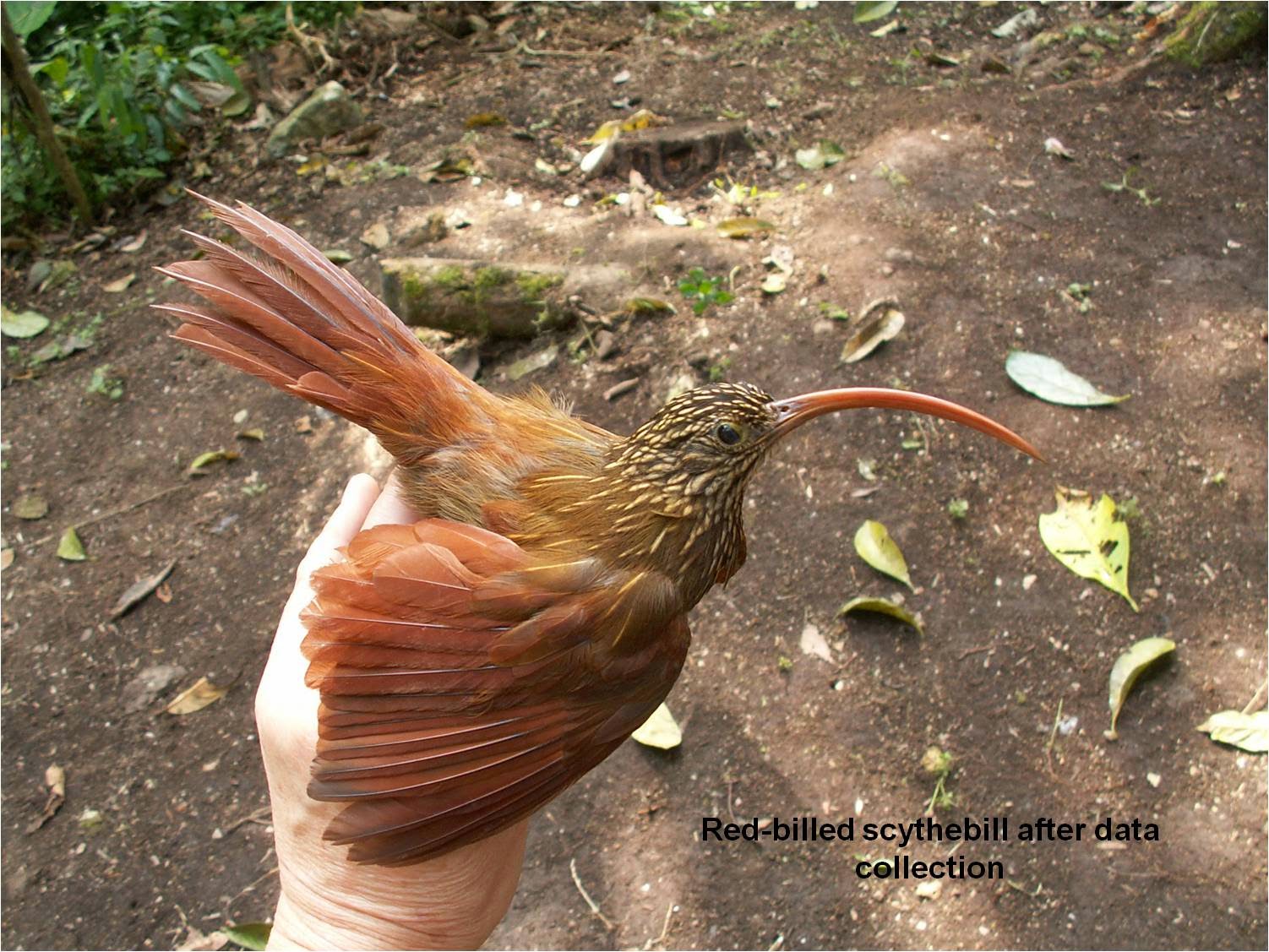
Top left clockwise: Erica feeding a banded hummingbird; Mauricio removing a bird from a mist net; Pascual with Red-billed Scythebill; banding a bird--the little film cans hold the different sized bands

Susan checking the field guide to ensure that we have identified the scythebill correctly (many look very similar); Susan and Donna recording data for Pascual; Susan fanning the tail of a speckled hummingbird; Susan's method of wrapping and weighing her hummingbirds

Pascual or Evelyng band and take the data on all birds other than hummingbirds, 
alternating volunteers for data entry. Marlene and Donna work best with Pascual as his pronunciation is difficult to decipher at times. For instance, he calls the gray-and-gold warbler, which we net several times, the “grin-go” warbler. This becomes a joke and all the gray-and-gold warblers soon become “gringos.”

After lunch, Susan asks for volunteers to hike to the hummingbird pasture to observe the hummingbirds for a couple of hours. Marlene and I and Erica, Evelyn, Chas, and Dawn  volunteer, and so set off after lunch, carrying extra nectar and feeders. On the way up, Evelyng and I who are hiking together see a tayra run across the path ahead of us. It looks to me like a large otter with a bushy tail. We also see a chestnut mandibled toucan. What a thrill!

Two photos from the Net of the Tayra--in the left photo one can see how it resembles a bushy-tailed otter; the right photo is of a grey-headed tayra
When we get to the pasture after an hour’s hike, we break into teams and observe and count the numbers and species of hummingbirds that visit our assigned feeder. Marlene and I  record violet bellied [4, 8], Green-crowned Brilliant [3], Rufous-tailed [7], Brown Violetear [2], Speckled [5], Amazilia [6], and Andean Emeralds [1]. The feeders are “ruled” by the Violet-bellies with the Rufous-tails being the most nervous, looking every which way for danger and barely daring to drink.


Susan is studying the endangered Esmeralda Woodstar hummingbird, but because it has been drier than normal for this time of year, we do not see any over the two weeks we are in the cloud forest. The Esmeralda, which looks a bit like our Ruby-throated Hummingbird, weighs only about 1.7 grams and is a little larger than a bumblebee. Below are photos of an Esmeralda Woodstar (left) and a Little Woodstar that I pulled from the Internet.

I was the first one down from the pasture so claimed the first shower. How good these bucket showers are after a hot sweaty day. I am soaked through after climbing to the mist nets to open them first thing in the morning and remain sweat soaked for the day. It’s not that it is so terribly hot (we get little direct sun because we are under the cover of the trees), but it is very close with nearly 100% humidity.

It has been a satisfactory and productive first day of “work,” and after a good dinner, I crawl into my tent for the night feeling good about the day.

Jan 20--Red-billed Scythebill

Friday, January 20, 2006
La Mona


We work the mist nets again in the morning, capturing a Red-billed Scythebill, Scale-backed Antbird, a Scale–crested Pygmy Tyrant, and a Violet-bellied Hummingbird (left), among others.


Red-billed Scythebill, Scale-backed Antbird, Scale-crested
Pygmy tyrant
When we get back to camp we find big bowls of popcorn, which the Ecuadorians often eat in their noonday soup, and the typical big midday meal: soup, rice, tomatoes, onions, beans, egg, fried plantain, juices, coffee, tea, cookies, snacks.  Ecuadorian coffee is hot milk to which is added instant coffee. I ask for Café Americano or simply agua calliente to get coffee made with water.

Alejandro finally came up to the camp last night. He and Carlos were out until early morning collecting specimens. They found three Fer de Lances, and a variety of frogs. Carlos plans to name a frog after Alejandro. He has already collected two species that he does not think are on record.


Carlos--no, he is not holding a frog or snake or lizard--only his cell phone

Jan 21--Mist Netting

Saturday, January 21, 2006
La Mono

Up at 5:00 for what has become our usual routine: Breakfast under the casita in the dark, illuminated only by candlelight and our headlamps. Out at 6 am to open the mist nets, each team to its own nets. Cathy and Jessica and I have our route and routine down and slog across the creek, climb the bank—which has become so deeply muddy that we have had to cut another trail around the original one—hike to the mist nets, unfurl the mist nets and stretch them out on the poles one at a time.


Mist nets are nearly invisible nylon mesh nets about 40 feet long and 8 feet high, strung between a couple of bamboo poles. The size of the mesh varies, depending on what kinds of birds you're trying to catch. For hummingbirds, the standard mesh is 24mm; for "average" birds, 36mm, and if you were primarily after large parrots or toucans, your net would have even larger holes. The largest bird we caught in the nets I think was a Collared Trogon (right), a pretty solid bird about 10 inches long.

Collared Trogan
The nets have 5 trammel lines stretched tightly between supporting poles, but the net between those lines is not stretched tightly at all. Almost any bird that flies into the loose, nearly invisible, net becomes entangled. The nets are black gossamer. Anything that touches them—including our clothing, sticks, leaves, insects—catches or gets tangled in the netting. We often have to free cicadas. Cicadas are everywhere in the Cloud Forest and louder than those in Oklahoma . . . if that can be believed. When they all set up a racket, it actually hurts the ears and we put our hands over our ears. But, these cicadas are a beautiful turquoise pattern and exceedingly  pretty. In fact, not realizing the numbers we would find at camp, I carried one carcass all the way up to the camp so that I could photograph it (definitely coals to Newcastle). We even got photos of one hatching out on a nearby tree (see below).

A gorgeous turquoise cicada hatching and getting its color
It is still dark when, after opening the nets, we return to the banding table and another cup of coffee while we wait the requisite 20 minutes before hiking back to the nets to untangle and bag caught  birds.We mist net for 5 hours each morning. Each day we net fewer birds as the birds become aware of the nets. This morning we band about 82 birds, 28 of them hummingbirds.

Evelyng holding a bird at the banding table; note the sheet for data bottom left
We have an hour of downtime after lunch, during which time a few of us play scrabble or rummy. After this, Susan and a group hike back up to the hummingbird pasture to monitor the feeders. Marlene and I stay down and sit under the casita to enter into the computer all of the data collected in the morning. It takes Marlene and me all afternoon to enter all these data on the birds we’ve captured this morning. We are proud when we enter the last item. Susan is very pleased.

Alejandro with one of the banded hummingbirds that is regainig its strength before flying away
Post-lunch downtime; me, Chas, and Dawn

Here are the data collected for each bird:  Date, Weather, Time, Bander, Site, Species, Band Size, Band Number, Age,  Age How (plumage, skull, primary feather wear), Sex, Sex  How (plumage, brood patch, cloaca, rectrix shape), CP (Cloaca Pr.) ( 0  = pres. but not enlarged, 1= slightly enlarged, 2 = large, diameter as large near tip as base, 3 = very large, diameter larger at tip than base), BP (Brood Patch )(0-5 for vascularization and wrinkles—evidence of brooding), Weight in grams, Wing Length in mm, Tail Length in mm, Culmen (Beak) Length  in mm (two measurements are taken for hummingbirds), Molt (1 = primaries or secondaries, 1-6 = molting symmetrically, 2A= no evidence of sequential wing molt, tail and wing feathers faded and worn; 2B = no evidence of wing molt, tail and wing feathers fresh), Ectoparasites (1 = none, 2 = tick, 3 = mite, 4 = lice, 5 = hippo, 6 = more than 2 types, 7 = unknown parasites), New or Recapture, Tarsus Measurements in mm (we do not measure the hummingbird’s tiny tarsus), Furculum Fat, Abdominal Fat, Body Molt (N = none, M= medium, H= heavy), Juvenile Plumage (estimated percentage), and Notes (any feather or color discrepancies noticed; oddities such as “missing all tail feathers,” “tick near left eye” etc).

When a bird is caught, it is handled with what's known as the "bander’s grip." This hold in which the head is between the first two fingers and the bird’s feet rest on the curled thumb, keeps the wings folded against the body and allows the naturalists to check the general condition of the bird, including its age and sex. The condition of the female indicates whether or not she is incubating eggs. If the brood patch shows that the bird is actively brooding, it is banded and then immediately returned to the spot where it was captured.

We are also taught how to how to hold a bird in the “photographer’s grip,” its feet secured between our fingers as shown. Hummingbirds cannot be held this way as it could damage their tiny legs. Most hummingbirds are photographed as they perch on a volunteer’s hand or as they are held loosely and offered nectar after being banded.

To weigh the regular birds, we weigh the bagged bird; then weigh the bag and subtract the bag weight from the total. To weigh the hummingbirds—the smallest weighing under 2 grams—we put a piece of fine mesh and clip on a scale, zero it, and then wrap the bird in the mesh, secure it with the clip, and weigh the wrapped bird on the tared scale. Stacy Peterson, an Eagle River, Alaska, hummingbird bander, says she simply lays the hummer on its back on the scale. She claims that the bird lies still to be weighed 95% of the time.

Jan 22--Last Day at La Mono

Sunday, January 22, 2006 
La Mono

I can’t believe that an entire week has gone by! This is our last day at La Mono. Tomorrow we finish our vegetation mapping and then move camp to Dusti’s original cabin (simply called La Casita) on the ridge higher up. Today, we run the morning mist nets for the last time in this location. The nets are fairly unproductive by this time as the birds have “gotten wise” to their existence. Nonetheless, we net a beautiful Spotted Nightingale Thrush [1] (actually a common bird in the mist nets), Slate-throated Whitestart [2], Orange-crowned Euphonia [3], and a Swainson’s Thrush [4], the last a North American migrant requiring a U.S. Fish and Wildlife band. Then we close the nets preparatory to vegetation survey/mapping of the 200 square yards around each net.

Spotted Nightengale Thrush, Slate-throated Whitestart,  Orange-crowned Euphonia, Swainson's Thrush
After lunch, we are divided into three teams. The Plot Dimensions Crew (Cathy, Chas, and Marlene) goes in first and maps out the perimeter of the survey area around each net, marking its borders with hunter’s orange plastic tape. Then my team, the Psychotria Marking Crew (Susan and me and Erica), goes in and identifies and ties a pink plastic ribbon to each Psychotria alba rubiaceae bush within these survey plots. Then the third team, the Mapping Crew (Donna, Dawn and Ricardo) goes in and draws a visual of each Psychotria on a piece of graph paper, noting the bush’s height, width, and bloom stage. Later in the week we spend an afternoon or two at the new site drawing a blueprint and keys of each plot, using colored pencils. Susan needs this information to determine whether hummingbird numbers are tied to the Psychotria plants on which they feed and to determine the difference between moist and dry environments on feeding and hummingbird numbers.
Psychotria alba rubiaceae

When the plot Dimensions Crew is working on the West net sites, Ricardo spots a Fer de Lance not a foot from the end of Mist Net #3W. It is small and young, but its parent is there also and slithers off. Carlos looks in vain for the parent but cannot find it. The crew is spooked, so Mauricio and Pascual finish that plot for them.

After the third team has finished at a net site, Mauricio and Pascual dismantle the mist net, collect the net and its bamboo poles, and load them onto the mules for the move to the ridge. Darkness falls and there are still five net sites that have not been plotted. Susan says that these can be done in the morning as our move to the ridge will be leisurely. In fact, we get to sleep in until 6 am tomorrow morning as we do not need to open mist nets.

Jan 22--Hummingbird Pasture

Sunday January 22, 2006
La Mona to La Casita

Today is moving day. We sleep in, eat a leisurely breakfast, fill our packs with bars and snacks and then set out, each team to a different destination. The Mapping Crew will stay at La Mono until they have finished mapping the five remaining plots; then they will hike directly to La Casita and begin setting up camp and all of the tents—all of which will be transported by the mules and horses that came up last night. Mauricio’s son, Jose, brings water on his horse, which is followed again by its darling foal. The Plot Dimensions team, Chas and Erica, will hike directly to La Casita and begin marking the plots around the 20 dry area nets near the camp (lower down the ridge), as these were not completed on the previous Earthwatch Expedition. The Ecuadorian naturalists (Mauricio and Pascual) will transport the mist nets to the new site and then begin erecting them in moist areas along the ridge above our camp.

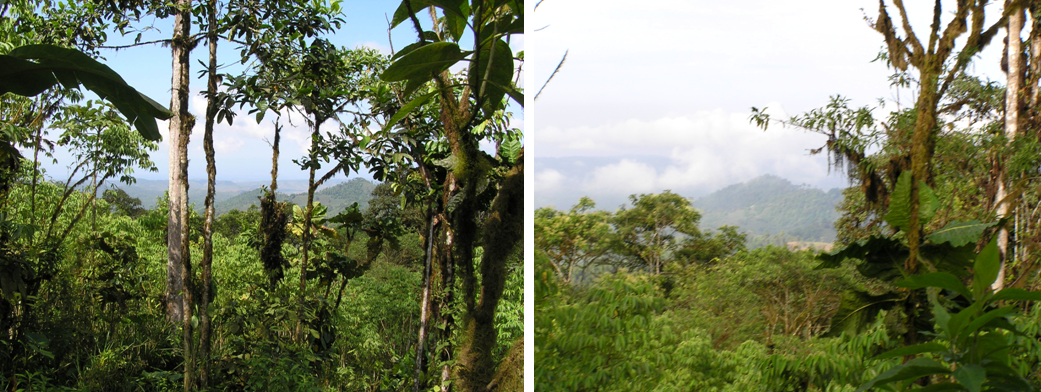
The rest of us (Cathy, Susan, Evelyng, Dawn, Marlene, and I) once again tackle the strenuous climb past the trail down to La Casita and hike to the hummingbird pasture at the top of the mountain, keeping an informal  bird count (both those seen and those heard) as we go. We like it up at the pasture because there are cooling breezes and this is an semi-open spot where one can look out over the mountains to the ocean. We feel freed from the tall trees and dense vegetation of the Cloud Forest. While called “the pasture,” this area is treed, but most of the trees are short and sparse and there is grass growing below them. This grass contains ticks (the smaller red variety actually balled atop the stems) and chiggers, so we are very careful not to wade into the grass, and we always seat ourselves on plastic bags. I’d give a lot for one of those camp chairs at the moment, or even one of those three-legged camp stools.


Swallow-tailed Kite, Plumbeous Kite, and Mississippi Kite

I see white birds way across the valley in a tree. When we get our binoculars on them we discover about 30 Swallow-tailed Kites, 8 Mississippi Kites, and 7 Plumbeous Kites flying in the updrafts and dipping below the ridgeline on the next mountain range over. We also see Black, Turkey, and King Vultures, some of which fly right over our mountain top.


Cathy and I walk the small mountaintop pasture and spot a Scarlet-backed Woodpecker, a pair of nesting Blue-gray Tanagers, several pairs of Lemon-rumped Tanagers (the male black with a yellow rump and the female yellow with greenish brown cap, wings, and tail), and a motley looking summer tanager, which may have been a brooding female or a second year male.  

Male Lemon-rumped Tanager, Female Lemon-rumped, Blue-gray Tanager, and Scarlet-backed Woodpecker

Cathy and I had started out ahead of the rest and so have about 45 minutes to ourselves in the pasture. We are sitting on plastic bags with our boots off giving our feet a rest when we hear a snicker in the bushes. A small foal has come up to the pasture from the other side of the mountain and is startled to find us here. It is standing not 15 feet from me. Cathy, who has horses and much experience with them, tells me to stand up. Foals will playfully paw at and trample things smaller than they she explains. She also tells me that the foal’s mother must be somewhere near as the foal would not stray very far from its mother. She is right. I stand and walk back down the trail and there are the mother and foal, standing in the shade of a tree. They’d come up for the grass, which doesn’t grow in the shade of the forest. Domestic animals are often on their own as far as finding food and thus roam at will. Some of the cattle and horses we’ve seen have hurt my feelings as they are tick ridden and look half starved, their ribs painfully evident.


View from the hummingbird Pasture. With binoculars, we could actually see the ocean in the far distance
Erica with bottle of drinking water; most of us wore long sleeves and long pants in the jungle because of the biting insects and snakes. I wore short sleeves but long pants, my Ex-officio Buzz off pants serving me well.
When Susan and the rest of the crew get to the meadow, Susan pairs us off and gives each pair of us a data sheet on which we are to keep track of the hummingbird species that visit our assigned feeder and the behavior of those that come in to eat. I am paired with Dawn. We find that the violet-bellied hummingbirds rule the roost, so to speak, guarding the feeder and chasing off all, including their own females who come to drink. Nevertheless, Andean Emeralds, Speckled, Green-crowned Brilliants, and Rufous-tailed Hummingbirds all manage to feed at our feeder. Often the feeder is ringed with females of different species who don’t seem to be as much of a threat to the guarding Violet-bellieds as the males of these species. The Rufous-tailed Hummingbirds we nickname “Woody Allens” because they are so nervous and flighty. They rarely perch more than a few seconds to feed and when they do, they strain to look for danger in all directions, occasionally “forgetting” to take a sip of nectar before flying off.

Green-crowned Brilliant at our feeder

After three 45-minute observations, we hike back down to the banding table which is where the trail diverges and goes down very steeply to our new camp, 30 to 45 minutes below, depending on one’s hiking speed. Donna and the rest of the Plot Measurement gang have managed to set up most of the tents, but mine and a couple of others that they could not find. Donna, Cathy, the cooks—Isadora and Emilia—and Carlos and Evelyng’s tents are set up under a large-diameter bamboo framework that is draped with black plastic and tarps. The rest of us are set up upstairs at La Casita in one large room. The stairs to this loft space are nearly ladder-like in their steepness. The showers at this site are similar to those at La Mono but they are on the hillside and slant down; also the black plastic has not been tacked as high, so tall people like me are not only exposed from the trail coming into camp but can also be seen from the dining area. (The Ecuadorians, who tend to be short, probably thought the plastic was adequate when they tacked it up.)

The dining area is not in a separate shelter as at La Mono but is under the casita, running along one side. There is a rail behind the benches, which gives those of us who sit on that side of the table the first backed seats we’ve encountered since leaving the Eco Lodge. I always try to seat myself on this side of the table. This camp is on a ridge so there is not much flat area around it. The worst part of this camp are the toilets, which are not actual toilet seats set over holes as in La Mono but pit toilets made low and of very rough timber. Near the first toilet is an old toilet seat, set on end and covered in moss, into which is engraved “R.I.-Pee.” The toilets are at the end of a trail through the jungle. We loop a piece of orange tape to trees at the trailhead when we want to signal that the toilet area is occupied.

We have barely gotten to camp when Donna yells: SNAKE! A long, brown snake has emerged from the second pit toilet. Though Carlos dives into the underbrush as usual, he cannot find the snake. Later that evening, after enviously listening to Carlos’ reports of seeing a kinkajou the previous night and after examining his latest frog and toad specimens, he confides to me that there is a large tailless scorpion under the pit toilet and did I want to see it. I’m almost sorry that I said yes. 

He takes me back, moves a board and there emerges the largest, most fearful creature that I’ve seen. It is an arachnid, according to Carlos, but it has hooked front legs like a scorpion, and it also has two antennae (I guess that’s what they are) that are about 10 or 12 inches long with which it captures food. It’s body is odd shaped too. There were actually two of them under the toilet, but the biggest one scooted out and onto the toilet wall, where I took several photos of it. Of course these photos were lost in the Guayaquil mix-up, so until/unless Carlos sends me his photos, the one below from the Internet will have to do. Notice that the photographer could not even get all of the antennae into the photo.


Tailless Whip Scorpion
I am one of the last in the shower, so shower in the dark, finding the new sloping flooring a challenge in dexterity. After the shower, I gratefully take the backed-bench side of the table and enjoy a well-earned meal. I also drink two cups of coffee—fool that I am. Thus I have a perfectly wretched  night --WIDE AWAKE -- for most of it, and when not tossing and turning on my light-as-air air mattress, negotiating the steep steps and running to the scary pit toilets three (count ‘em) times through the jungle in the dark. Each time I shine my headlamp only where needed. Ostrich-like, I do not want to see too much. Nonetheless I spot a hairy tarantula on the spare lumber near the trail on one of my trips down.